
MINGKE Bio-based Renewable Leather from Genuine Leather Recycling
How Recycled Genuine Leather Waste & Bio-Based Materials Are Redefining Sustainable Luxury
 From Scraps to Leather: The Environmental Revolution of Real Leather Recycling
In the fashion and daily necessities industry, real leather is favored for its unique texture. However, the large amount of leftover materials generated during tanning and leather goods production was once a pain point for the industry. These leather fragments, once regarded as "waste", now have a magnificent transformation under the empowerment of technology. Through scientific recycling and recombination processes, they are reborn into recycled leather with both quality and environmental protection properties, injecting new vitality into resource circulation.
The Secret of Turning Waste into Treasure: The Birth Journey of Recycled Leather
The production of recycled leather is not a simple splicing process, but a set of precise and controllable industrial processes. Each step aims to maximize the retention of the characteristics of real leather while realizing efficient resource utilization. The latest technology has solved the problems of poor hand feel and unstable quality of traditional recycled leather, enabling recycled leather to reach the use effect comparable to original leather.

Step 1: Raw Material Screening and Pretreatment
Recycling starts from the source, where we collect various types of real leather scraps such as cowhide and sheepskin generated by tanneries and leather goods factories. With the combination of manual sorting and intelligent equipment, impurities are first removed to ensure the purity of raw materials, followed by professional cleaning and disinfection to eliminate stains and microorganisms, laying a solid foundation for subsequent processing.
Step 2: Crushing and Fiber Refinement
The pretreated scraps are sent to special equipment, first crushed into fine particles, and then mixed with an appropriate amount of water to make leather pulp. After deep processing by a refiner, these particles are converted into fine leather fibers, and this delicate treatment is the core link to ensure the high-quality hand feel of recycled leather.
Step 3: Scientific Slurry Preparation and Shape Shaping
The fine leather fibers are mixed with environmentally friendly additives in scientific proportions to form a uniform slurry. This special formula can improve the toughness and softness of the leather. The slurry is evenly spread on the conveyor belt, and after a short period of standing for shaping, the initial dehydration is completed through the conveyor belt to prepare for subsequent shaping.
Step 4: Dehydration, Shaping and Fine Processing
The leather blank after initial dehydration will go through a double pressure filtration process to remove excess water and form a compact basic shape. It is then sent to a drying room for drying to remove residual moisture. The dried leather blank is then subjected to surface finishing such as edge cutting, grinding and ironing, and finally becomes a smooth and flat recycled leather product.

Both Environmental Protection and Practicality: The Dual Value of Recycled Leather
The significance of recycled leather goes far beyond "turning waste into treasure". From the perspective of environmental protection, it can digest hundreds of thousands of tons of leather waste every year, reduce environmental pollution caused by incineration and landfill, and at the same time reduce resource consumption caused by the mining and processing of new leather materials. From a practical point of view, it combines the air permeability of real leather and the durability of PU, with soft hand feel and high simulation, and is widely used in leather goods, furniture, shoe materials, automotive interiors and other fields.


Data shows that producing 1 ton of recycled leather can save ecological resources equivalent to 20 adult trees and reduce carbon dioxide emissions by about 3 tons, which is an important path for the fashion industry to achieve "carbon neutrality". |
Today, recycled leather is no longer a synonym for "secondary materials", but a model of the combination of environmental protection concepts and industrial technology. When we choose recycled leather products, we are not only choosing a high-quality texture, but also casting a vote of support for resource circulation. In the future, with the continuous upgrading of technology, this "rebirth of scraps" will surely shine in more fields.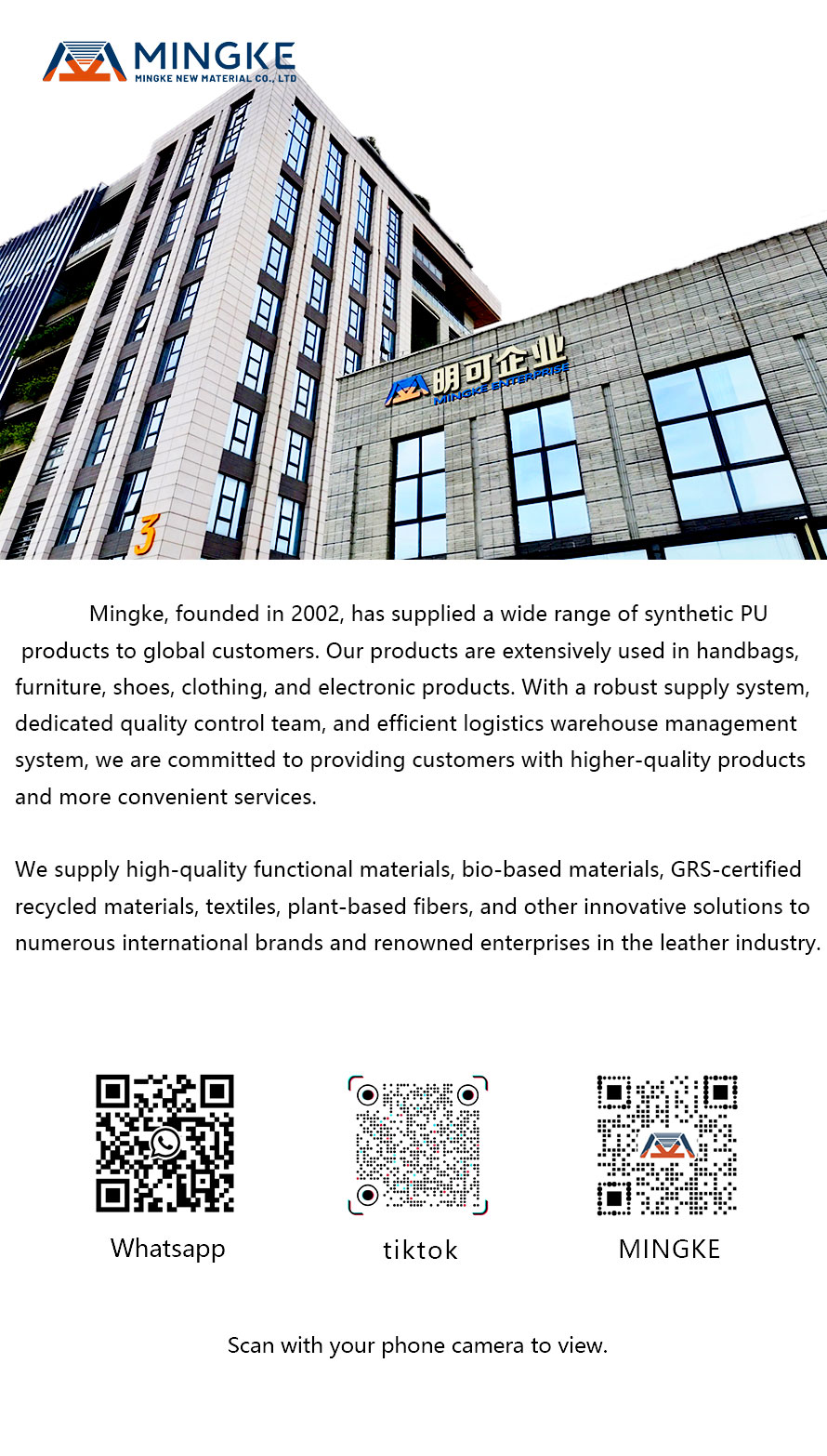
Contact Us | CONTACT
Get your exclusive samples and technical solutions: Our expert team is ready to assist you.
Tel: +86-20-84646188
Fax: +86-20-84640082
WhatsApp|WeChat: 18102687893
Email: mingkenewmaterial@gmail.com
Follow Mingke New Materials for more industry insights and innovation updates.
Website: https:// www.mingke.ltd
No. 233 Pingkang Road, Shiqiao, Panyu District, Guangzhou, Guangdong Province, China

Product Applications


